Nobody sits down at their kitchen table reading divorce paperwork and thinks, “great, now let me calmly figure out what happens to the house in a divorce.” But that’s where a lot of people find themselves. The house is probably the most expensive thing you own together, it’s tangled up in a mortgage, and every room carries some kind of memory that makes rational thinking really difficult right now.
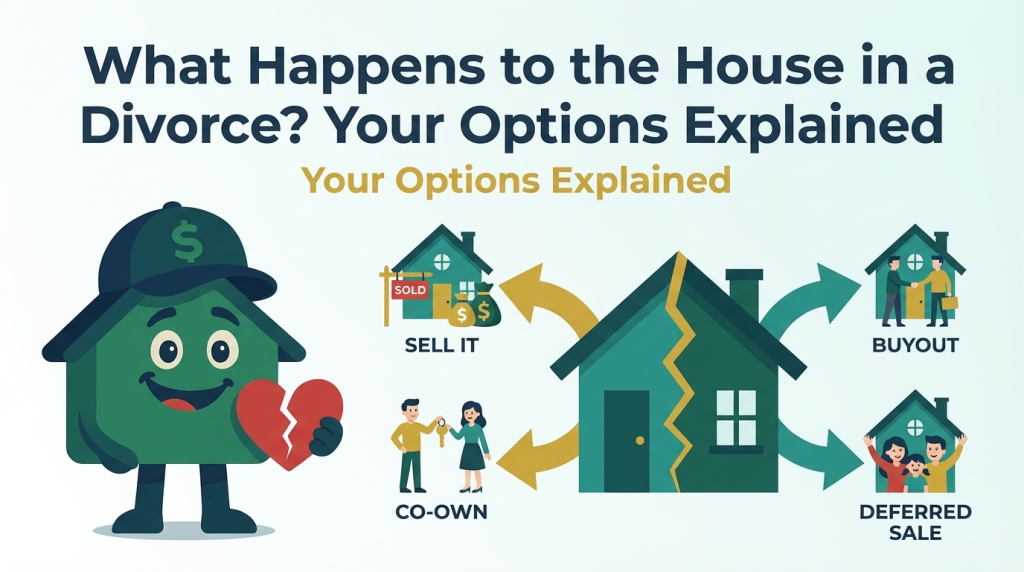
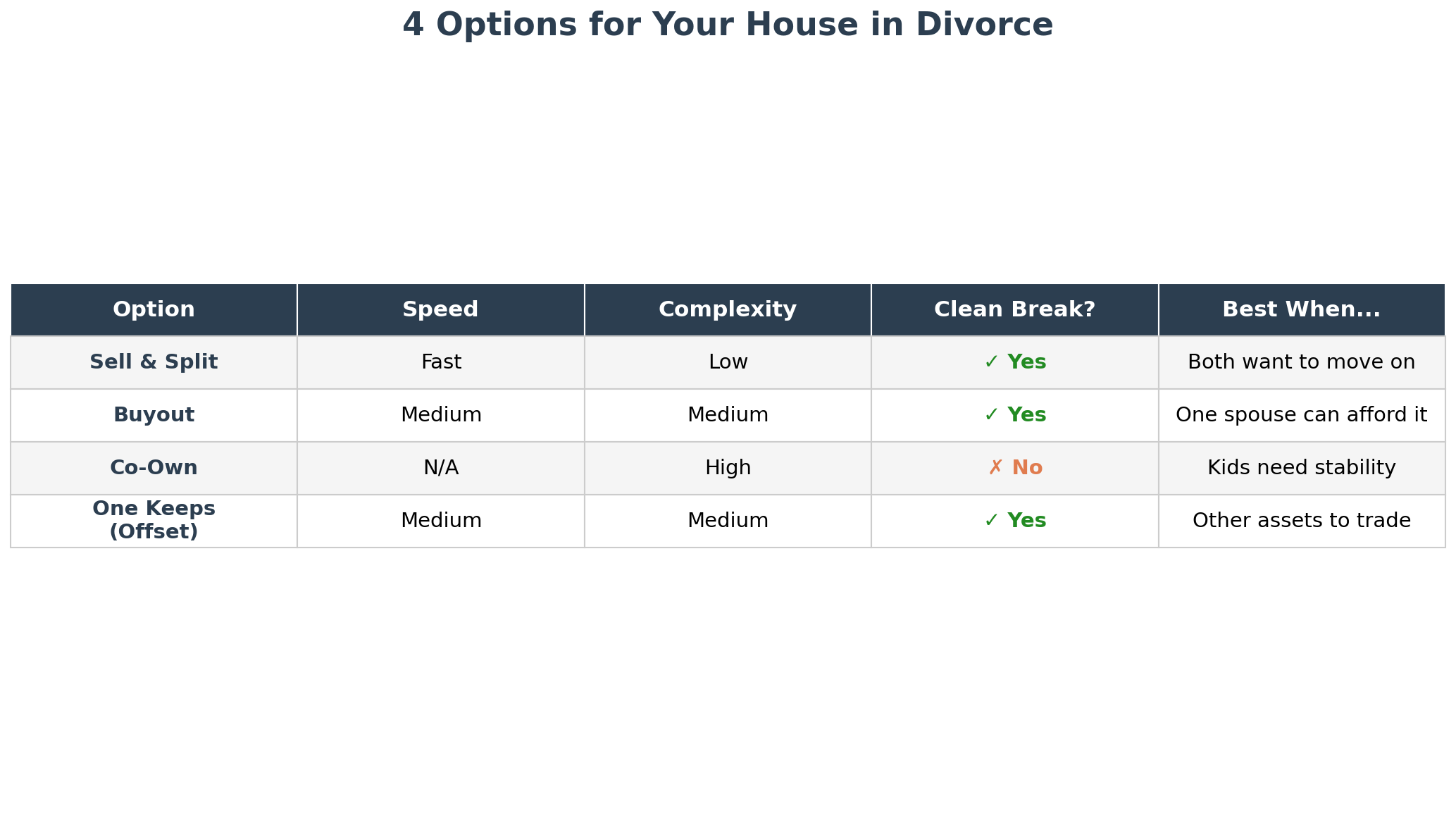
I’m going to cut straight to what matters. Four paths forward exist. And if you need to sell a house during divorce, the first option is usually the fastest. Sell the place and divide up the cash. Have one spouse buy the other one out. Keep co-owning the property for some agreed-upon stretch of time. Or one person walks away with the house while the other gets a bigger share of different assets.
Those are your divorce house options. All of them. There aren’t secret fifth and sixth choices hiding somewhere.
Which path works for your situation, though? That comes down to where you live, what your mortgage looks like, whether kids are in the picture, and – being honest here – how much you and your soon-to-be-ex can stand to cooperate on shared financial decisions. Let me walk you through each piece.
Your 4 Actual Options for the House in Divorce
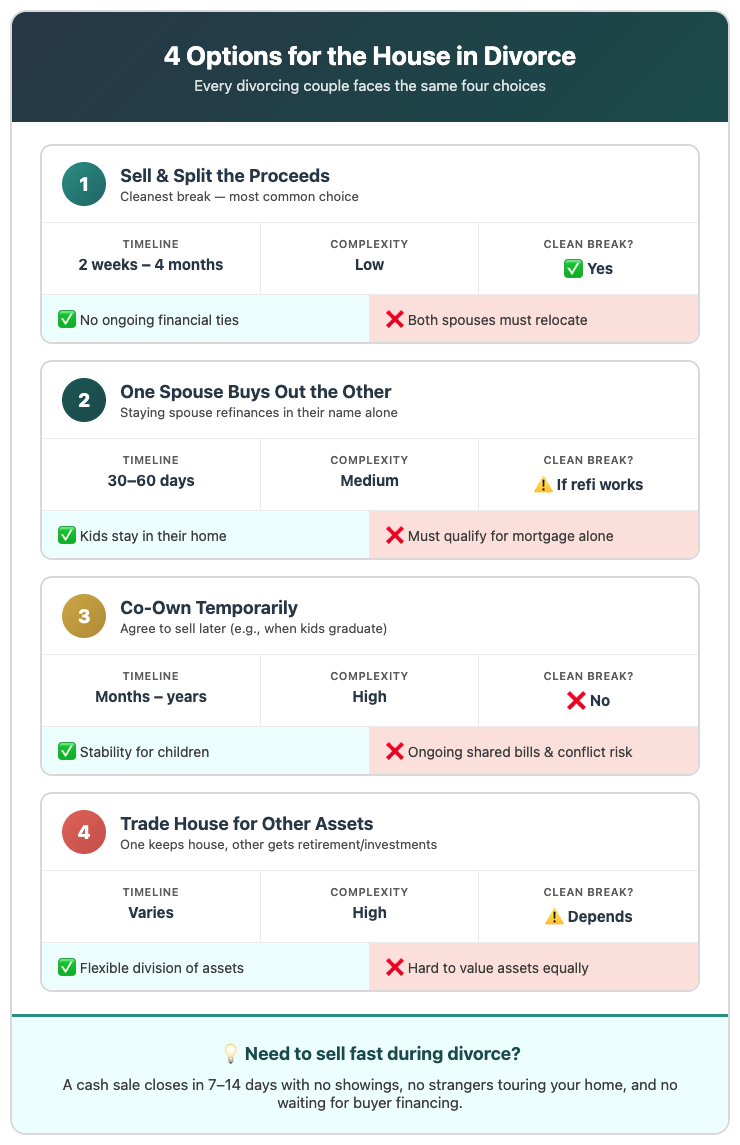
Every couple asking what to do with house in divorce lands on this same list. I’ll own that bias up front: we think selling is usually the right call. But let me lay out all four so you can decide.
Selling a House During Divorce – Split What’s Left
Most financial planners will tell divorcing clients to sell. There’s a reason for that. You offload the mortgage, take the remaining cash, split it per your agreement, and nobody owes the other person anything on the property going forward.
No shared bills. No texting your ex about a broken furnace in January. Done.
The catch? Both of you have to move, and that’s especially rough with school-age kids who’ve got their whole social world in the neighborhood. NAR’s August 2026 survey reports a 31-day median time on market and a separate 30-day median to close. These figures don’t set a minimum timeline for your sale. Throw in open houses and strangers touring your living room while your personal life is falling apart, and yeah – it’s a lot.
That’s a big reason so many divorcing couples come to us about selling their house for cash. No fixing things up, no staging, no parade of buyers poking around your closets. I’ll get deeper into that option toward the end.
One Spouse Buys the Other Out
Maybe one of you really wants to stay. The kids’ rooms, a home office setup that took years to get right, whatever. A buyout means the staying spouse pays the leaving spouse their share of the home’s equity.
Quick example to show how this plays out. Let’s say your home appraises at $350,000 and you’ve still got $200,000 on the mortgage. So $150,000 in equity total. If you’re splitting things evenly, the person who stays writes a check for $75,000 – or works out some equivalent trade in other assets.
Now, $75,000 doesn’t just materialize out of thin air. Usually it’s a refinance with cash pulled out. Or the spouse keeping the house gives up their claim on retirement accounts or other investments to balance things. There’s room to get creative with it.
The part people forget: whoever stays has to qualify for that new mortgage alone. Banks don’t care that you used to have two salaries covering the payment. They’re underwriting based on one income now, and plenty of people find they can’t actually get approved solo. The refinancing itself runs a few thousand dollars in closing costs and appraisal fees on top of everything else.
Co-Owning After the Divorce (Temporarily)
Some couples decide to hold onto the house together for a set number of years. It’s usually about the kids finishing school, or waiting for a better real estate market, or giving one spouse time to rebuild financially.
To be fair, this works out fine sometimes. I’ve talked to folks who co-owned for three or four years after the divorce was final and it went smoothly because they spelled everything out on paper ahead of time.
But the couples where it goes sideways? Way more common. You absolutely need ironclad written terms covering who pays the mortgage each month, who handles repairs, who’s living there, and what triggers a forced sale. Without that, you’re asking for a second round of legal fights.
California Family Code Sections 3800 through 3810 lay out specific rules for deferred sales when minor children are involved. Other states have their own versions. The point is: this arrangement exists in law, but it comes with strings.
Staying financially attached to someone you just divorced is a big ask. Don’t agree to it without a lawyer reviewing the terms.
One Person Gets the House in the Settlement
The last option: one spouse takes the house, no buyout check, and the math gets balanced through other assets. One spouse keeps a home worth $300,000 that has maybe $100,000 in equity built up. The other spouse takes the investment portfolio, a vehicle, and a bigger chunk of savings. On a spreadsheet, the columns balance.
Sounds tidy on paper. In practice, who keeps the house in divorce this way still has to deal with the mortgage situation, which I’m about to explain. And it creates a problem I see constantly.
Community Property States vs. Equitable Distribution States
Your state has a huge say in how the house gets divided. Not all states play by the same rules. Wildly different, actually.
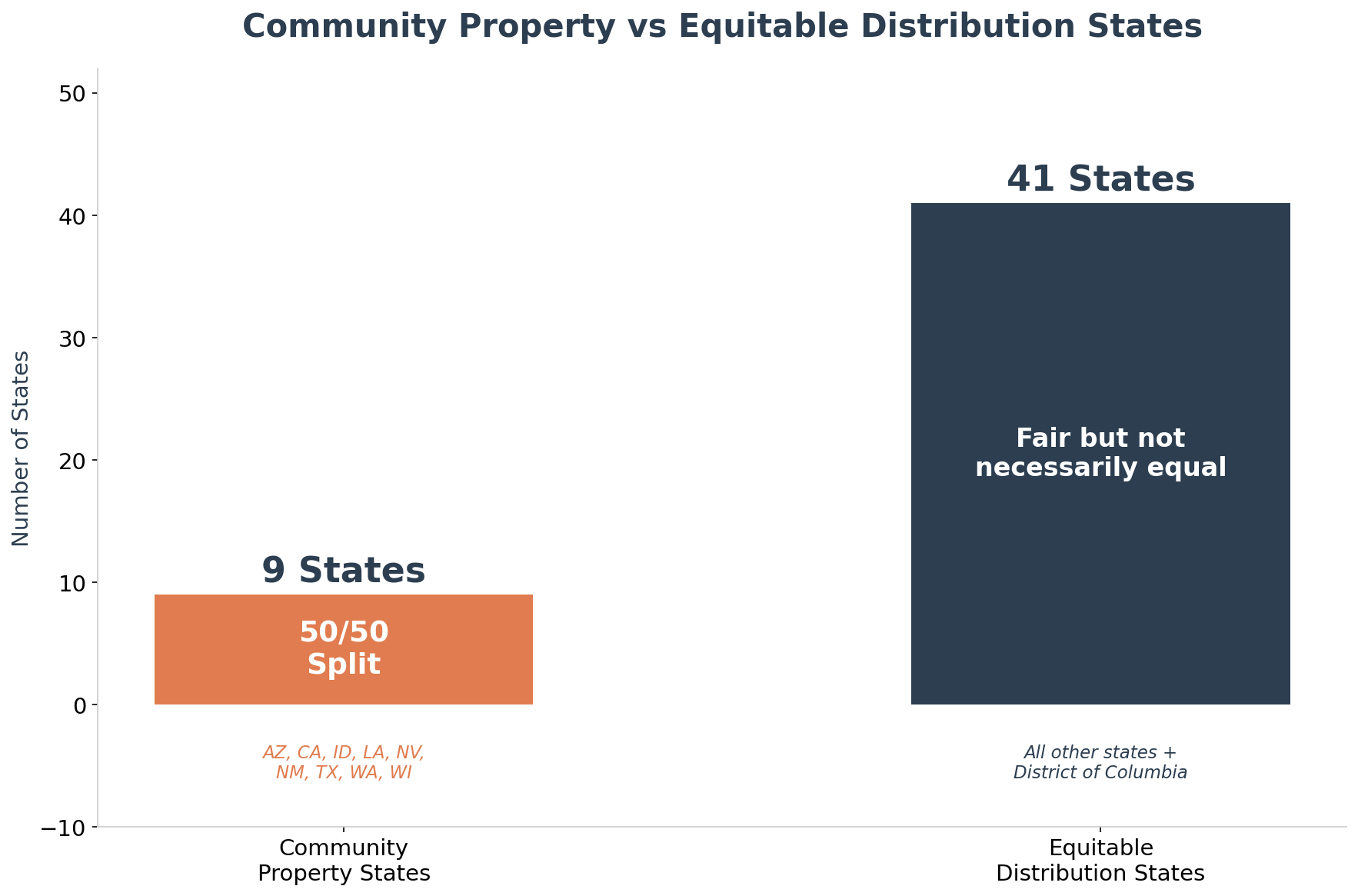
In Arizona, California, Idaho, Louisiana, Nevada, New Mexico, Texas, Washington, and Wisconsin, you’re dealing with community property law. Alaska has a version where couples can choose to opt in. The basic idea in these nine states: anything you bought or earned while married, both of you own it. Doesn’t matter one bit whose name went on the deed at closing. Doesn’t matter if only one person’s paycheck covered the mortgage. Married when you bought it? It’s a community asset.
Texas couple buys a house in 2019, divorces in 2025? Both people own that house equally under Texas law. End of discussion.
The other 41 states run on equitable distribution, and the word “equitable” trips people up. It means fair. Fair doesn’t automatically mean 50/50. A judge could decide 60/40 makes sense given the circumstances, or 55/45, or really any ratio they think reflects the situation honestly.
I should point out – even in 50/50 community property states, nobody’s sawing the house in half. The 50/50 part applies to the total value of all marital assets combined. One person might get 100% of the house while the other gets a bigger portion of retirement funds and it still comes out to a 50/50 total. The house itself doesn’t have to be divided equally. Just the overall pie.
What Courts Actually Look At When Deciding Who Gets the House
Most couples hammer out the property split between themselves or through mediation. The American Bar Association notes that mediation resolves the vast majority of these disputes without a judge ever weighing in. Saves money and headaches compared to a courtroom battle.
When agreement falls apart, though, the judge takes over. This is what’s running through a family court judge’s mind when they’re deciding who gets the house in a divorce:
Where the kids are going. This is the big one. If there are minor children, courts strongly prefer keeping them in the family home when it’s financially doable. The parent with primary custody usually gets first shot at the house. The Uniform Marriage and Divorce Act puts children’s best interests at the top of the priority list.
Who paid for what over the years. Down payment money, monthly mortgage payments, home improvements. If one person shouldered more of the housing costs, especially in equitable distribution states, courts notice that.
What each person can earn going forward. Did one spouse leave the workforce to raise kids for a decade? That difference in earning power factors heavily into who gets what. Courts try to account for the financial sacrifice.
How long you were married. A couple who built equity together over 20 years is in a different situation than newlyweds who’ve owned the home for 18 months. Longer marriages generally mean more equal splits.
Everything else on the balance sheet. Debts, retirement accounts, health problems, other real estate. Judges are looking at the full financial picture, not just the house in isolation.
The Mortgage Trap When You Sell House During Divorce

This part is critical. I need you to really hear this.
Whatever your divorce decree says about mortgage responsibility, your lender didn’t agree to it. The bank doesn’t read your divorce papers. Both names are on the loan? Both of you owe that money until someone refinances or you sell.
Picture this scenario. Your divorce agreement says your ex-wife handles the mortgage from now on. Three months later she misses a payment. Your credit score tanks. The bank sends you a collections notice. You call them, wave your divorce decree around, and they say “that’s nice, but you signed this loan.”
The Consumer Financial Protection Bureau has addressed this directly – the original mortgage contract survives divorce proceedings completely intact. Only two things remove your name: refinancing into the other person’s name alone, or paying off the loan through a sale.
This is honestly the number one reason we see people choose to sell their house quickly. They don’t want to gamble their credit on whether an ex-spouse makes payments for the next couple decades.
And here’s a mistake that happens all the time: quitclaim deeds. One spouse signs a quitclaim deed giving up their ownership interest in the property. They think they’re done. They’re not. A quitclaim deed transfers ownership rights. It does absolutely nothing to the mortgage. Your name stays on that loan. You are still on the hook. I can’t tell you how many people learn this the hard way.
Should I Sell My House in Divorce? Why Keeping It Might Cost More
Getting the house in a divorce feels like winning something. Give it six months on a single paycheck and the math starts looking very different.
That $2,200 mortgage payment your two incomes handled without much stress? On one salary it might eat 40% or more of your take-home. And the mortgage is only the beginning.
Property taxes don’t adjust for your divorce. The county sends the same bill regardless of how many adults live there.
Then there’s upkeep, which people dramatically underestimate when they’re fighting to keep the house. Roof starts leaking and suddenly you’re staring at an $8,000 to $15,000 bill you never planned for. AC craps out in the middle of July? Another $5,000 to $10,000. The National Association of Home Builders says typical annual maintenance runs about 1% of what your home is worth. On a $350,000 house, that’s $3,500 a year just to keep things from deteriorating. And that’s before anything major breaks.
Insurance premiums hold steady or go up. Utility bills don’t drop because you lost a spouse.
People end up what financial advisors call “house poor.” They own property they can’t truly afford. Every dollar goes to keeping the roof over their head and nothing goes to savings, retirement, or actually living. I’ve watched people cling to a house for emotional reasons and regret it within a year.
If that’s where the math lands for you, selling your home fast and using the equity to set up somewhere affordable might be the wisest thing you can do for your financial future.
How to Sell a House During Divorce Fast With a Cash Buyer
I won’t pretend we’re unbiased here. We buy houses for a living. But the reason divorcing couples keep choosing this route is practical, not sentimental.
It’s fast. Conventional listings take months from start to finish. A cash sale closes in a week, maybe two. When you’re trying to split a life in half, dragging things out for 90+ days helps nobody.
You skip repairs entirely. Cash buyers take homes exactly as they are. That rotting deck, the outdated bathrooms, the basement that smells a little weird when it rains – doesn’t affect the offer. Nobody’s asking you to dump money into a house you’re leaving.
No open houses or showings. One walkthrough, maybe a second. That’s it. Compare that to weeks of keeping the house spotless for strangers.
The deal actually closes. Regular buyers fall out of contract constantly. Financing gets denied, inspection reports spook them, the appraisal comes in under the agreed price. Cash deals don’t have those failure points. When your divorce settlement hinges on the sale going through, that certainty counts for a lot.
Clean financial split. Proceeds get divided, both names come off the mortgage, and that shared financial obligation is gone for good. There’s a reason cash sales pair so well with the benefits of selling a house for cash that we’ve written about separately.
Worth noting: you’ll get less than full retail value. You’re paying for the speed and the convenience and the guaranteed close. A lot of people going through a divorce look at that trade and decide the discount is worth every penny.
Ready to Sell House in a Divorce? What to Do This Week

Knowing your divorce house options is step one. Actually taking action is step two. This is what I’d tackle immediately:
Get a real valuation. Not an online estimate. Those can swing 5 to 10 percent in either direction. Get an actual appraisal from a licensed professional, or at minimum a CMA from a local real estate agent who’s sold in your neighborhood recently.
Pull up your latest mortgage statement. You need the exact payoff balance, your interest rate, and whether your loan has a prepayment penalty hiding in the fine print. Can’t make good decisions without these numbers.
Sit down with a family law attorney. Even one consultation changes everything. The difference between community property and equitable distribution alone could change your entire strategy, and a blog post (even this one) can only tell you so much. An hour with a local family law attorney is some of the best money you’ll spend during this process.
Do the budget math honestly. Grab a calculator and actually add up the mortgage, property taxes, homeowner’s insurance, and annual maintenance. Run those numbers on paper. Not in your head where optimism lives, but on paper where reality lives.
Get competing offers. If selling is on the table, get a market estimate from an agent AND a cash offer from a direct buyer. Having both numbers side by side gives you an honest comparison so you pick what’s actually best for your situation, not just what feels right.
Frequently Asked Questions
Can I sell my house during a divorce, or can a judge force the sale?
They can, and they do. It’s called a partition action, and it gives the court authority to order the property sold with proceeds divided however the judge sees fit. This isn’t some dusty legal theory that never actually happens. Judges order forced sales when somebody is dragging their feet, making ridiculous claims about how much the house is worth, or flat-out refusing to negotiate. I should mention – you lose a ton of control when a judge makes this call instead of you and your ex reaching your own agreement. Negotiate if you possibly can.
My name isn’t on the deed. Do I still have a claim on the house?
Almost certainly yes, assuming you bought the place while married. Community property states don’t care at all whose name went on the title at closing. Bought during the marriage? Both of you own it. Period. Equitable distribution states are a little different, but you can still claim a share based on mortgage contributions, money you put into renovations, or the fact that your family’s whole setup depended on one person earning income and the other running the household. Now, a house your spouse owned before you got married is typically separate property. That said, any equity that built up during your years together might still be considered marital. Bottom line: don’t assume you’re out of luck just because your name’s missing from a document. Get a lawyer’s read on it.
Does having kids change who gets the house?
Massively. Having minor children reshapes the entire property conversation. Family courts lean hard toward keeping kids in the home they already know, so the parent with primary custody usually gets first dibs on staying. That’s not guaranteed, though. The court also asks a very practical question: can this parent actually afford to live here alone? Handing someone a house they can’t keep up with doesn’t do the kids any favors. It just trades one type of upheaval for another. So judges balance what the children need emotionally against what makes sense financially.
Can I sell my house after divorce if my ex stops making mortgage payments?
Then your credit takes a hit right alongside theirs. Doesn’t matter what the divorce decree says about who’s responsible. Joint mortgage means both names, both liable, both on the hook when a payment is late or missed. The lender treats you as a unit no matter how your divorce papers divide things up. This exact nightmare scenario is why so many financial planners and divorce lawyers push hard for selling the house. Once the house is sold and the loan is paid off, your ex’s future financial decisions stop affecting your credit. If trust is an issue – and let’s be real, it usually is by this point – selling and getting out fast removes a huge ongoing risk.
Should I sell house before divorce or is there a deadline after?
There’s no blanket rule that applies everywhere. Your individual divorce decree or settlement might set a specific timeline, though. Some orders give you 90 days, some give you 180, some are vague about it. Vague timelines are a recipe for fights down the road, so push your attorney to include clear deadlines in whatever agreement you sign. If you end up needing to sell on a tight court-ordered schedule, cash home buyers can typically close in 7 to 14 days, which gives you a realistic option even with a looming deadline.
Do I have to sell my house in a divorce, or does everything get split 50/50?
In community property states, the total value of marital assets gets divided equally. But “equally” applies to the whole pot, not each individual thing. You might get 100% of the house and your ex gets the retirement accounts and it comes out to 50/50 overall. In the 41 equitable distribution states, there’s no 50/50 requirement at all. A judge weighs factors like each person’s income, their contributions to the marriage, future earning potential, and health issues, then divides things in a way that seems fair given all of that context. Fair and equal are two very different concepts in family law.